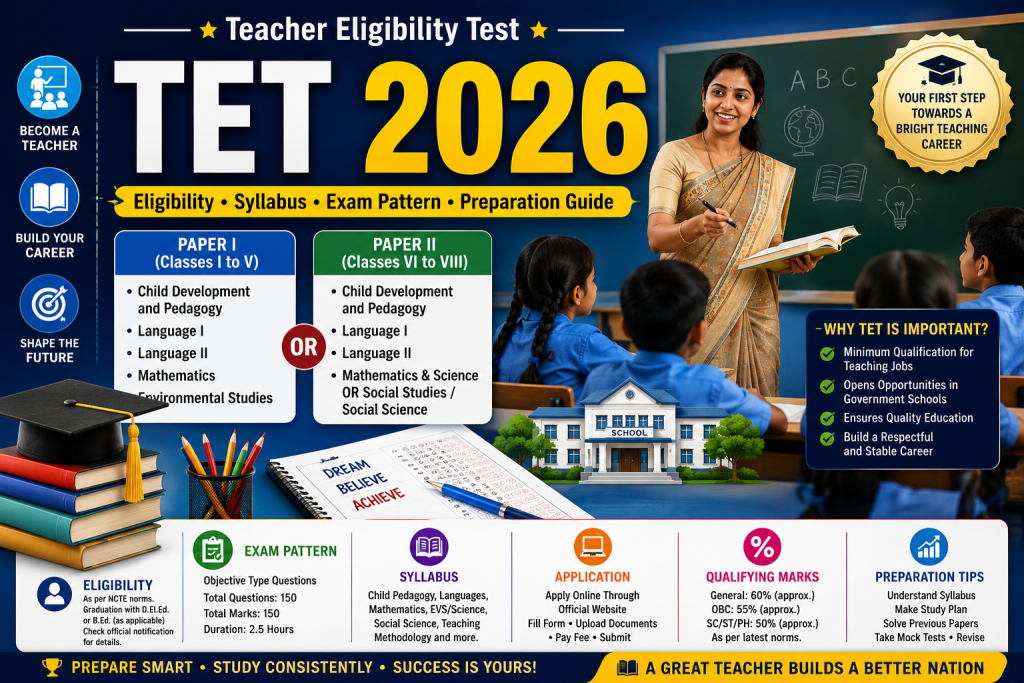
The Teacher Eligibility Test (TET) is one of the most important examinations for candidates aspiring to become teachers in government and government-aided schools across India. Conducted at both the central and state levels, TET serves as the minimum qualification for teaching positions in primary and upper primary schools.
Whether you are preparing for CTET or a State TET, understanding the eligibility criteria, exam pattern, syllabus, and preparation strategy is essential for success.
What Is TET?
The Teacher Eligibility Test (TET) is a certification examination that assesses the teaching aptitude and subject knowledge of candidates who wish to teach children from Classes I to VIII.
There are two levels:
- Paper I: For candidates who wish to teach Classes I to V.
- Paper II: For candidates who wish to teach Classes VI to VIII.
Candidates interested in teaching Classes I to VIII generally appear for both papers.
Types of TET Exams
There are two main categories:
- CTET (Central Teacher Eligibility Test) – Conducted for central government schools.
- State TET – Conducted by individual state governments for recruitment in state schools.
Each state may have its own eligibility rules and recruitment process.
Eligibility Criteria
While eligibility varies slightly across exams, candidates generally need:
- Senior Secondary or Graduation (depending on the paper)
- A recognized Diploma or Bachelor’s degree in Education (D.El.Ed., B.Ed., or equivalent as applicable)
- To satisfy the educational qualifications prescribed in the official notification
Candidates should always refer to the latest notification for the specific TET they are applying for.
Exam Pattern
Paper I (Classes I–V)
Subjects generally include:
- Child Development and Pedagogy
- Language I
- Language II
- Mathematics
- Environmental Studies
Paper II (Classes VI–VIII)
Subjects generally include:
- Child Development and Pedagogy
- Language I
- Language II
- Mathematics & Science (for Science teachers) or
- Social Studies/Social Science (for Social Science teachers)
Most TET exams consist of objective-type multiple-choice questions.
TET Syllabus
The syllabus typically covers:
- Child psychology and pedagogy
- Language comprehension
- Teaching methodologies
- Mathematics concepts
- Environmental Studies
- Science
- Social Science
- Classroom management
A thorough understanding of concepts is more important than rote memorization.
Qualifying Marks
The qualifying percentage may differ depending on the examination authority and applicable reservation policies.
Qualifying TET makes candidates eligible to apply for teaching positions, but it does not guarantee appointment. Recruitment usually involves additional selection processes conducted by the respective authorities.
How to Apply
The application process generally includes:
- Register on the official examination portal.
- Fill in the online application form.
- Upload the required documents.
- Pay the examination fee.
- Submit the application.
- Download the confirmation page for future reference.
Candidates should ensure that all information is accurate before final submission.
Preparation Tips
To improve your chances of success:
- Understand the latest syllabus.
- Solve previous years’ question papers.
- Take regular mock tests.
- Revise pedagogy concepts thoroughly.
- Practice time management.
- Strengthen weak subjects through consistent study.
Career Opportunities After TET
Qualifying TET opens opportunities to apply for teaching positions in:
- Government schools
- Government-aided schools
- Kendriya Vidyalayas (subject to recruitment rules)
- Navodaya Vidyalayas (subject to recruitment rules)
- State government schools
- Various educational institutions where TET qualification is accepted
Why TET Is Important
TET ensures that teachers possess the minimum professional standards required for classroom teaching. It helps improve the quality of education by selecting candidates with appropriate teaching aptitude and subject knowledge.
Conclusion
TET 2026 is an important milestone for anyone aspiring to build a career in teaching. With a clear understanding of the eligibility criteria, exam pattern, syllabus, and consistent preparation, candidates can significantly improve their chances of qualifying. Stay updated with the official notification of the respective CTET or State TET examination and prepare strategically to achieve your teaching career goals.